
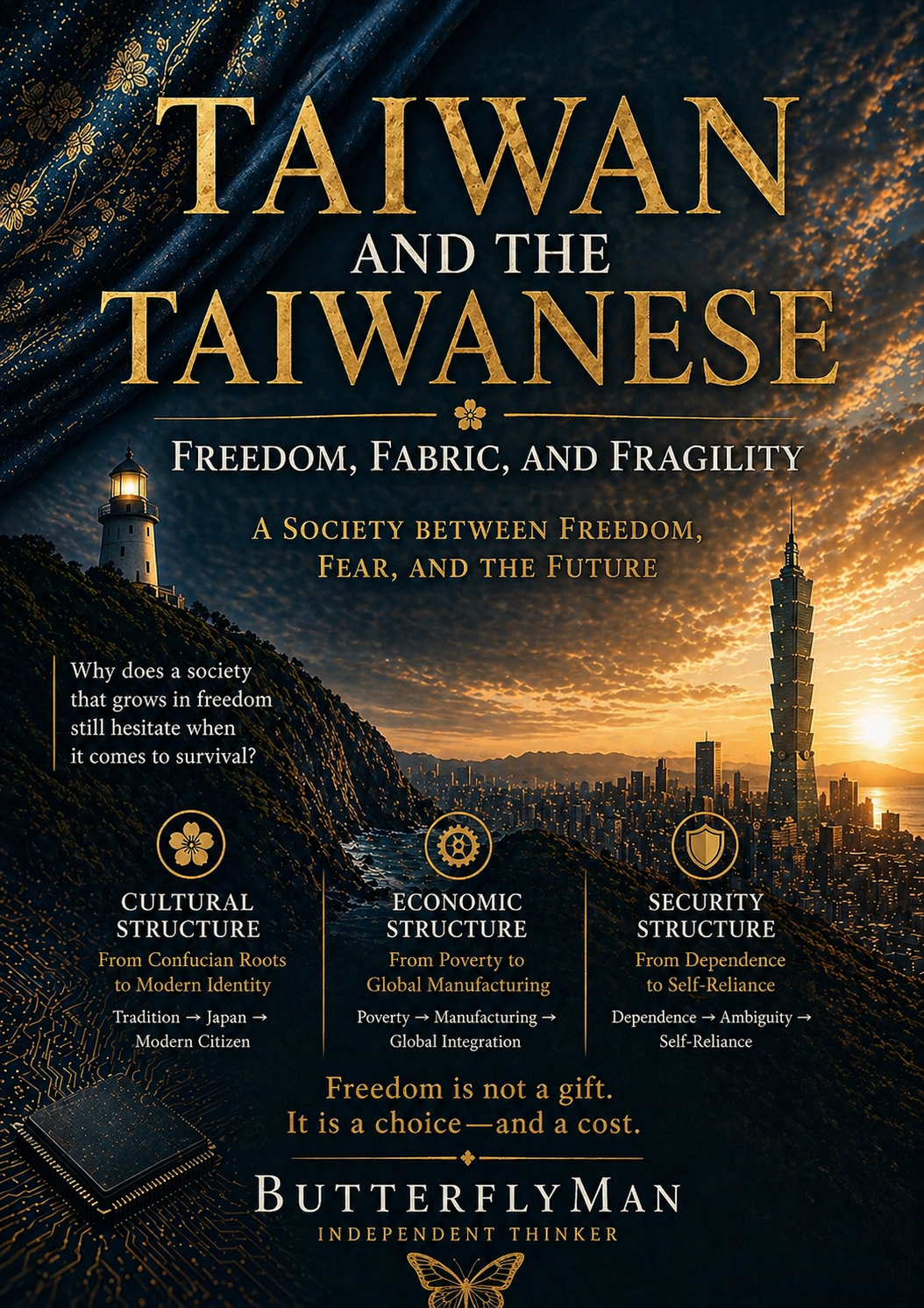
ButterflyMan Releases Taiwan and the Taiwanese: A New Book Exploring Freedom, Civilization, and the Future of Taiwan

Taiwan’s future will not ultimately be secured by chips. It will be secured by people.
NEW YORK, NY, UNITED STATES, June 15, 2026 /EINPresswire.com/ -- ButterflyMan Releases Taiwan and the TaiwaneseA New Book on Freedom, Civilization, Democracy, and the Future of Taiwan
“Freedom is not a gift. It is a choice—and every meaningful choice carries a cost.”
Independent thinker, author, and manufacturing strategist ButterflyMan announces the publication of his latest book, Taiwan and the Taiwanese: Freedom, Fabric, and Fragility.
Part civilizational analysis, part political philosophy, part social observation, and part economic study, the book examines Taiwan not merely as a political entity, but as one of the most significant social transformations in the modern Chinese-speaking world.
At its heart, the book asks a question that extends far beyond Taiwan:
What happens after freedom?
For decades, Taiwan has often been discussed through the lens of geopolitics, sovereignty, military tension, and cross-strait relations.
This book takes a different approach.
It asks not simply what Taiwan means politically, but what Taiwan reveals about freedom, institutions, culture, trust, responsibility, and modern civilization.
From Mainland China to Taiwan
Born and raised in mainland China, ButterflyMan grew up hearing a single message repeated throughout his childhood:
“Taiwan must be unified.”
According to the author, this idea was rarely presented as a question.
It was presented as an answer.
After decades working in global manufacturing and international trade, traveling across Asia, Europe, North America, and beyond, he gradually encountered Taiwan directly—not through political narratives, but through its people, businesses, institutions, and society.
What he discovered challenged many assumptions.
Taiwan is not merely “another China.”
It is a society that has already entered the structure of modern civilization.
The difference, he argues, is not merely institutional.
It exists in deeper layers:
• cultural logic
• social structure
• civic behavior
• individual consciousness
• rule of law
• public trust
Taiwan’s uniqueness is therefore not simply political.
It is civilizational.
A Society That Chose a Different Path
The book argues that Taiwan represents one of the most important experiments in modern Chinese history.
While mainland China experienced revolutionary movements, political campaigns, and the Cultural Revolution, Taiwan gradually moved toward another path.
A path built on:
• constitutional government
• democratic institutions
• rule of law
• individual choice
• civic participation
The lifting of martial law in 1987 and the first direct presidential election in 1996 marked more than political reforms.
They represented a civilizational shift.
Power became constrained.
Rule of law began replacing rule by individuals.
Society began protecting the individual.
Citizens gained the ability to choose.
Lee Teng-hui and the Civilizational Turning Point
One of the book’s central themes is the role of former Taiwanese President Lee Teng-hui.
ButterflyMan argues that Lee’s significance extends far beyond Taiwan.
In his view, Lee accomplished something rarely achieved in Chinese history:
the peaceful transfer of political legitimacy from authority to citizens.
Instead of preserving power indefinitely, Taiwan’s democratic transition gradually changed the source of legitimacy itself.
From the perspective of civilizational history, ButterflyMan argues that Lee Teng-hui may be one of the most important and most underestimated figures in modern Chinese history.
Beyond Politics: A Study of Modern Society
The book explores the hidden structures that shape societies:
• culture
• economy
• security
• identity
• family
• human behavior
Through Taiwan’s experience, the book presents a rarely discussed reality:
A society can change its institutions,
but not necessarily its people.
Major themes include:
• Taiwanese character and social psychology
• family transformation and individual choice
• language, communication, and conflict avoidance
• democratic institutions and civic participation
• manufacturing, trust, and economic development
• freedom, responsibility, and social resilience
The Philosophy of Taiwanese Manufacturing
Drawing on nearly four decades of manufacturing experience, ButterflyMan argues that Taiwan’s economic success cannot be explained simply through capital, labor, or technology.
Taiwan’s greatest industrial asset is trust.
The book examines how Taiwan became one of the world’s most important manufacturing hubs through:
• specialization
• long-term thinking
• quality systems
• decentralized SME networks
• global integration
From precision machinery to semiconductors, Taiwan developed a manufacturing culture that values reliability over spectacle.
The book argues:
Taiwan’s manufacturing success is not merely an industrial miracle.
It is an institutional miracle.
Freedom, Determination, and the Responsibility of Survival
The experiences of Hong Kong, Ukraine, and Israel offer three different lessons.
Hong Kong demonstrates that prosperity alone cannot preserve freedom.
Ukraine demonstrates the importance of national will.
Israel demonstrates the power of long-term preparation, innovation, and societal resilience.
The lesson for Taiwan is clear:
No alliance can replace self-defense.
No external power can permanently guarantee the future of a society unwilling to defend itself.
Yet Taiwan’s future should not be reduced to military spending or weapons procurement.
Many observers believe Taiwan’s greatest strategic asset is its semiconductor industry.
This book argues otherwise.
Semiconductors matter.
Technology matters.
Economic importance matters.
But chips do not defend a society.
History shows that societies survive not because of what they manufacture, but because of what their people are willing to defend.
Ukraine did not survive because of industrial output.
Israel does not survive because of technology alone.
Both survived because society itself possessed the determination to survive.
Taiwan’s greatest strategic asset is therefore not TSMC.
It is not semiconductors.
It is not even international support.
Taiwan’s greatest strategic asset is the collective determination of twenty-three million people to preserve their freedom, democracy, and way of life.
Technology, innovation, and defense capabilities are essential.
But they are tools.
Without determination, tools are meaningless.
Without social will, technology becomes vulnerable.
Without civic responsibility, prosperity becomes fragile.
Taiwan must therefore build resilience at every level:
• individual resilience
• family resilience
• community resilience
• technological resilience
• industrial resilience
• cyber resilience
• national defense resilience
Every citizen has a role.
Every institution has a role.
Every community has a role.
The objective is not war.
The objective is deterrence.
The objective is to build a society so resilient, innovative, technologically advanced, and determined that any attempt to coerce, invade, or subjugate Taiwan would face overwhelming resistance, extreme uncertainty, and an unacceptable probability of failure.
Taiwan must develop defense capabilities across every layer of society:
• military capability
• technological capability
• cyber capability
• industrial capability
• infrastructure resilience
• civic preparedness
• national determination
The purpose is not to seek conflict.
The purpose is to preserve peace.
History demonstrates that peace is most durable when aggression is least likely to succeed.
The strongest deterrent is not rhetoric.
It is the clear understanding that the cost of aggression would be unbearable.
Any attempt to invade Taiwan should carry consequences so severe that no rational decision-maker would consider it a viable option.
The price would not be measured only in military losses.
It would include:
• economic disruption
• technological isolation
• political instability
• international consequences
• long-term strategic exhaustion
The objective of Taiwan’s defense strategy should therefore be simple:
Not merely to resist invasion,
but to ensure that any aggressor understands from the very beginning that the cost of invasion would be unaffordable, unsustainable, and ultimately greater than any possible gain.
The safest Taiwan is not one that hopes others will save it.
The safest Taiwan is one that possesses sufficient capability, innovation, resilience, and determination that war itself becomes an irrational choice.
Peace is preserved when aggression cannot succeed.
Freedom is preserved when society is willing to defend it.
And survival depends not on chips alone,
but on the vision, preparation, tools, and determination of the people themselves.
Freedom survives when individuals possess both the vision to understand what is at stake and the tools necessary to defend it.
Taiwan’s challenge is therefore not merely technological.
It is civilizational.
Can a free society transform prosperity into resilience, freedom into responsibility, and democracy into determination?
The answer to that question may determine Taiwan’s future.
Taiwan’s future will not ultimately be secured by chips. It will be secured by people.”
“The strongest guarantee of peace is not hope. It is the clear understanding that aggression cannot succeed.”
A Question for Taiwan—and for Civilization
Ultimately, Taiwan and the Taiwanese is not only about Taiwan.
It is about a broader question facing modern societies everywhere:
Can freedom survive?
Can institutions endure?
Can individuals remain free in an age of increasing pressure and uncertainty?
The book suggests that the future of Taiwan depends not only on its economy or political system, but on whether its people are willing to recognize a simple truth:
Freedom is never inevitable.
It survives only when people are willing to protect it.
Taiwan’s future, ButterflyMan argues, will not be determined solely by military balances or geopolitical competition.
It will also be determined by whether Taiwanese society develops the confidence, resilience, and determination necessary to preserve the freedoms it has spent generations building.
About the Book
Title: Taiwan and the Taiwanese
Subtitle: Freedom, Fabric, and Fragility
Author: ButterflyMan
Genre: Civilizational Analysis / Political Philosophy / Social Structure
Languages: English, Traditional Chinese, Japanese
Publication Year: 2026
About the Author
ButterflyMan is an independent thinker, author, and manufacturing strategist whose work focuses on civilization, institutions, manufacturing systems, democracy, freedom, and the future development of modern societies.
His previous works explore Japan, artificial intelligence, manufacturing philosophy, social systems, and the future of Chinese society
Media Contact
ButterflyMan
New York, USA
Website: ButterflyMan.com
Email: contact@butterflyman.com
ButterflyMan
butterflyman publishing LLC
contact@butterflyman.com
Legal Disclaimer:
EIN Presswire provides this news content "as is" without warranty of any kind. We do not accept any responsibility or liability for the accuracy, content, images, videos, licenses, completeness, legality, or reliability of the information contained in this article. If you have any complaints or copyright issues related to this article, kindly contact the author above.
